
 59 minutes ago
1
SEE YOUR AD HERE
A South African Human Rights Commission inquiry has found widespread weaknesses in water and sanitation services across Gauteng, including ageing infrastructure, high water losses, inadequate technical capacity and growing reliance on water tankers
2 NOV 2026, 17:50
9 min read
The South African Human Rights Commission has warned that Gauteng’s worsening water crisis cannot be explained simply by a lack of water, pointing instead to ageing infrastructure, high water losses, weak municipal distribution systems and failures across the institutions responsible for getting water to households.
Releasing the commission’s 171-page report on its Gauteng water inquiry on Monday, inquiry chair Henk Boshoff said it was ironic that the findings were being presented while large parts of the province were battling persistent water outages for days or weeks on end.
“As we speak, people don’t have access to water. I thought municipalities would beef up their performance in the days before the local government elections. Instead, the opposite happened. Rather than improving, things just went haywire.
“We cannot continue to sit in boardrooms,” he told municipal managers and officials. “We cannot sit here, release reports or have meetings. Meetings have obviously not assisted. It has not contributed to the lives and livelihoods of ordinary people in Gauteng province.”
The inquiry, held in May, examined water and sanitation services across the province’s nine water services authorities. It followed persistent complaints from residents and community organisations about prolonged interruptions, leaking infrastructure, inadequate sanitation and concerns about water safety and reliability.
The department of water and sanitation told the inquiry that sufficient water resources were available to meet current demand, although further augmentation would be needed in future. The problem, the commission found, lay in the systems needed to move, store and distribute the water.
Ageing infrastructure, high water losses, insufficient reservoir and pumping capacity, electricity interruptions, bulk-supply failures and weaknesses in municipal distribution all contribute to unreliable services.
“The availability of water at source does not, by itself, ensure that communities receive water that is safe, sufficient and reliably available at the point of use,” the report says.
The inquiry found that aggregate municipal access figures could conceal severe shortages in particular neighbourhoods. Johannesburg, for example, met minimum water access standards across the domestic service points recorded in National Treasury data, but community submissions described prolonged interruptions and long-term reliance on alternative supplies.
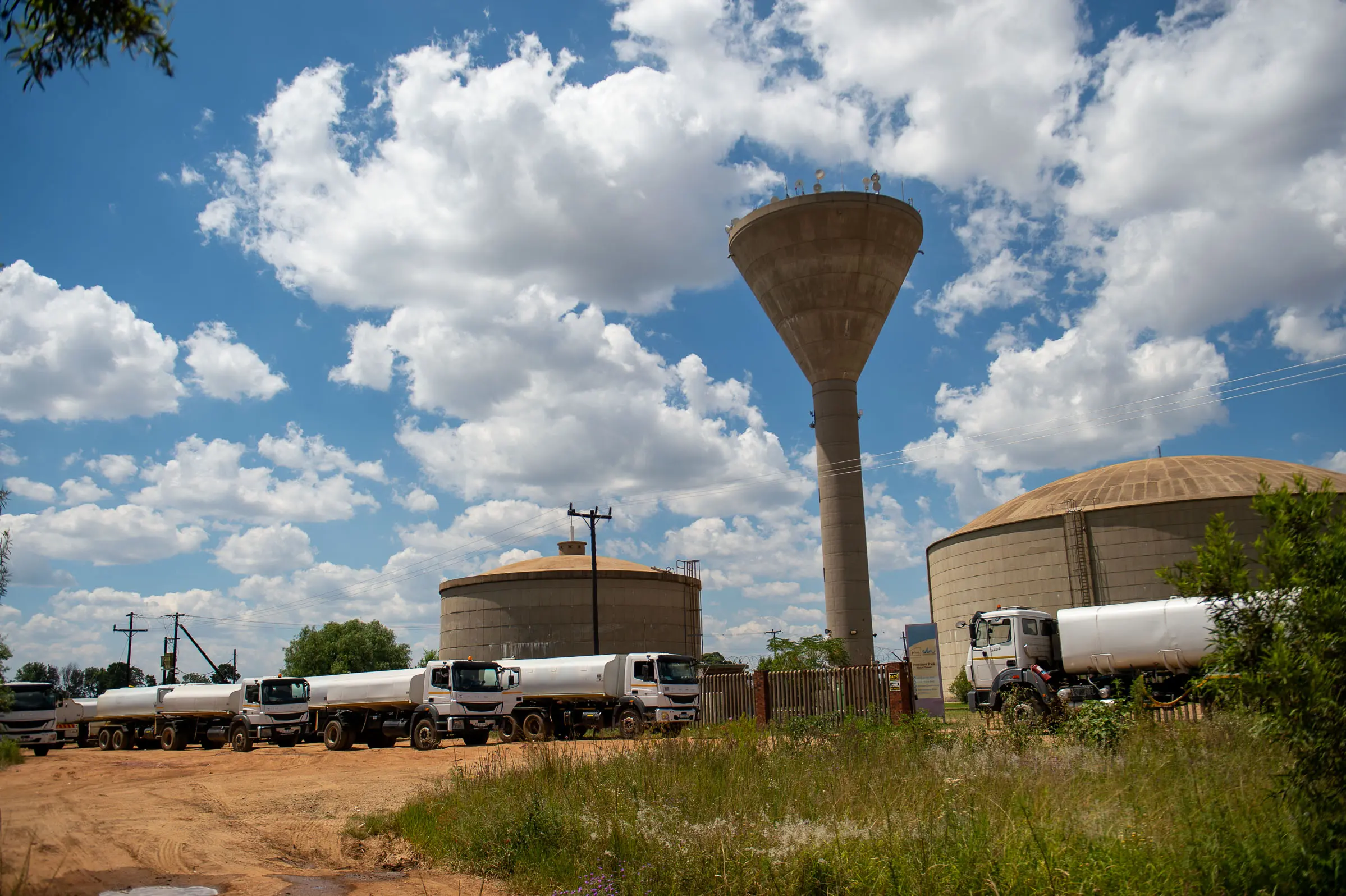
Johannesburg Water used about 52 tankers and 1 500 stationary tanks to supply more than 300 informal settlements. Some communities had relied on those arrangements for years. Although the city’s monitored drinking-water system showed strong microbiological and chemical compliance, the evidence submitted to the inquiry did not include sample results from tanker and static-tank supplies.
The report identifies the growing use of tankers as a shift from emergency response to a regular part of water provision. It describes that as a “road-based water distribution network”: recurring deliveries by vehicle, either directly to communities or to static tanks, as part of a municipal supply system.
Tshwane reported servicing informal settlements through 282 tankers, about 1 150 static 5 000 litre tanks and a further 106 static 10 000 litre tanks.
The commission said that form of distribution needed standards covering water quality, accessibility, procurement, cost-effectiveness, monitoring and accountability.
“Such recognition must not however normalise or entrench an inferior permanent level of service … It is simply not acceptable where metropolitan municipalities are spending hundreds of millions of rands a year on water tankering.
“Those hundreds of millions of rands could have been used to upgrade your infrastructure to provide continuous water provision to people, but you have decided it’s more lucrative for the service provider and municipal employees to rather perpetuate the procurement of water tankering for self interest.”
Boshoff criticised the cost of tankering and the way it is procured. “Water tankering has become a brazen form of corruption and financial mismanagement,” he said.
Citing figures for Tshwane, he said expenditure had risen from R47 million in 2021/22 to R777 million in 2024/25, before falling to R362 million in 2025/26.
The report says the evidence before the commission was insufficient to reach a conclusion about allegations of corruption in tanker procurement.
“The amount of money that is spent on water tankering [in Tshwane] is just astonishing, hundreds of millions of rands, approaching a billion rand per year and one wonders who is benefiting,” he said.
The report also examines how responsibility is divided across the water-services system. Municipalities remain responsible for ensuring residents receive water and sanitation, but interruptions can originate in bulk water infrastructure, electricity supply or functions performed by other institutions.
The commission described municipalities as “cost shock absorbers”, managing the immediate consequences of failures that might originate beyond their control. This does not remove their responsibility for problems in their own systems.
It finds significant shortages of engineers, scientists, process controllers, artisans and other technical staff needed to operate and maintain water and wastewater infrastructure. Financial-management weaknesses, including unresolved unauthorised, irregular, fruitless and wasteful expenditure, also affect some municipalities’ ability to maintain services.
The report raises questions about accountability for wastewater treatment in Emfuleni and Rand West City, where Rand Water performs operational and maintenance functions.
While the municipalities retained their statutory responsibilities as water services authorities, the commission said operational failures could not fairly be attributed solely to a municipality where Rand Water exercises day-to-day control.
Wastewater treatment across the province is a major concern. Mogale City’s Green Drop score was 29.9%, placing it in the critical risk category. The commission recommends prioritising failing and at-risk treatment works according to the risks they pose to human health, water resources and downstream users.
The inquiry also examined the February 2026 bulk-water disruptions, when failures at Rand Water’s Palmiet and Zuikerbosch pump stations and a major pipe burst affected supply.
The commission found that municipal systems’ ability to withstand bulk interruptions depends on their own storage, pumping and distribution capacity. Some municipalities took longer to recover after bulk supply was restored because reservoirs had been depleted and their systems lacked resilience.
The report criticises the proliferation of plans, forums, task teams and monitoring platforms where these do not translate into improved services.
“The existence of plans, forums, task teams, dashboards and institutional structures cannot itself be treated as evidence of improved service delivery,” it says. “Another meeting will not fix the pipe.”
The scale of water losses in the three metropolitan municipalities illustrates the financial cost of deteriorating infrastructure. Johannesburg loses about 44.8% of water flowing through its municipal pipelines, valued at R2.82 billion.
Boshoff said that exceeded Johannesburg Water’s entire annual capital budget.
The entity’s estimated infrastructure renewal backlog is R27 billion, with about R2.5 billion a year needed over the next decade for replacement and renewal, substantially more than its current capital budget of about R1.7 billion.
The report also raises questions about the financial relationship between Johannesburg Water and the city, including the city’s sweeping account, intercompany loans and whether water services revenue is retained and reinvested in the function. But it cautions that the evidence does not independently establish that revenue has been unlawfully or improperly diverted.
Tshwane loses about 39% of its water, valued at R1.7 billion, and has an estimated infrastructure backlog of R23 billion. The commission also identified severe institutional and technical capacity constraints.
Although recorded domestic service points meet minimum access standards, the city experiences interruptions linked to municipal network failures, bulk-supply disruptions, maintenance, infrastructure constraints and illegal connections. Wastewater treatment is another serious weakness.
Ekurhuleni’s water losses are about 25.4%, valued at R1.27 billion. Although this falls within national treasury’s guideline range, the commission identified ageing infrastructure and inadequate storage as significant risks.
About a quarter of the city’s reservoirs have less than 24 hours of storage capacity. Its wastewater system achieved a Green Drop score of 81.7%, but seven of its 17 treatment works were operating at or above design capacity.
The commission criticised the level of cooperation it received from municipalities. All nine were ultimately subpoenaed to secure their participation. Eight appeared before the panel; Rand West City did not attend and submitted written information only after the hearings.
“The level of cooperation required to secure municipal participation in this inquiry is concerning, all but one of the city managers or municipal managers had to be subpoenaed to appear before the inquiry …
“The Constitution is very clear: organs of state must provide the commission with the assistance reasonably required to exercise its powers and perform its functions.
“Cooperation is not a matter of courtesy or etiquette; it is a legal obligation. When municipalities withhold cooperation, they undermine the constitutional mechanism established to monitor, protect and advance the human rights of the people they serve.”
The report makes eight overarching recommendations involving 19 state and sector institutions, including all nine Gauteng water services authorities. These include strengthening technical capacity, developing guidelines for road-based water distribution, prioritising failing wastewater treatment works and improving the resilience of the bulk water system.
Boshoff said the commission had done its part by investigating the problems and identifying the action required from organs of state. He said Gauteng Premier Panyaza Lesufi had been presented with the report on Friday, had adopted it unreservedly and pledged support for implementing its recommendations.
“Sanitation is the hallmark of human dignity. Asking for a toilet that is safe and hygienic is not asking for a luxury. It is asking for dignity,” said Boshoff.
“Water is the lifeblood of human existence and there is no life without water. The failure to deliver water is not just another administrative mishap, it has real life consequences. We all need to put our shoulders to the wheel to address this massive challenge.”

 English (US) ·